

ChatGPT Will Replace 95% of Substack Writers by 2030. Here's How to Be the Top 5% Who Thrive
The strategy that turns AI from your biggest threat into your most powerful assistant—and why your human "flaws" are about to become your greatest assets

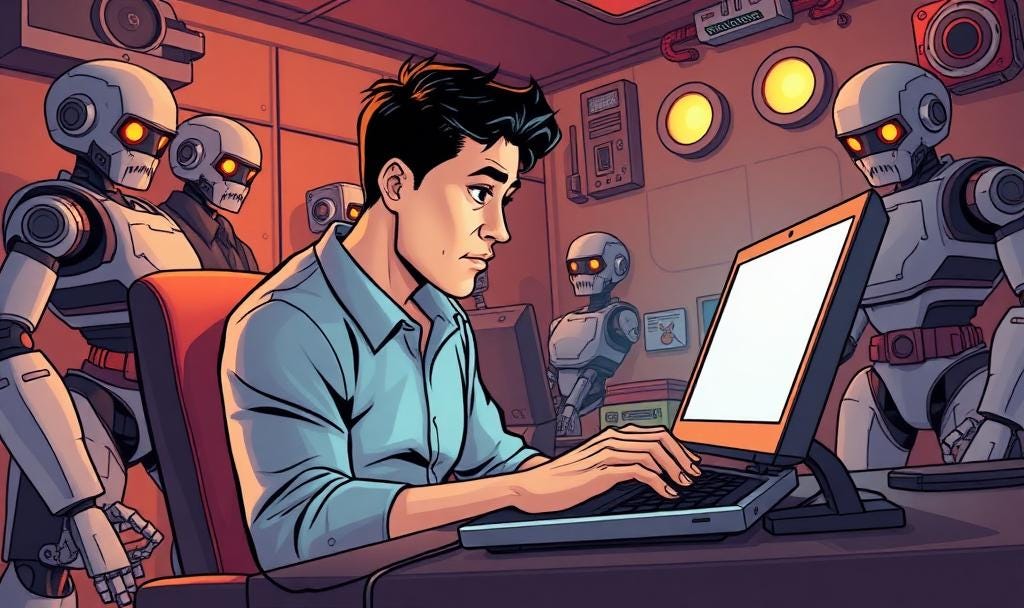
Last week, I did something that seems a bit unorthodox.
I fed my entire newsletter archive into ChatGPT and asked it to write my next post about newsletter growth.
Thirty seconds later, it handed me a perfectly structured, well-researched article with actionable tips, compelling examples, and even a strong call-to-action at the end.
I sat there looking reading this new post, realizing that AI actually did a pretty good job. Better than "pretty good," if I'm being honest.
For a moment, I felt that existential dread that every writer is dealing with right now: "If AI can do this in 30 seconds, what's the point of me spending hours crafting the perfect post?"
I closed my laptop and went for a walk, spiraling through all the worst-case scenarios. Maybe this whole newsletter thing was just a temporary gig before the robots took over. Maybe I should start learning to code. Maybe…
Then I remembered something that shifted my perspective.
Two weeks earlier, I'd gotten an email from a subscriber. She'd been struggling to grow her newsletter for months, consuming every piece of growth content she could find. She'd read all the "expert" advice, including AI-generated articles that perfectly explained newsletter strategies.
But she was still stuck at around a few 100 subscribers.
Then she joined my Substack masterclass—not because it was the most comprehensive resource available, but because it was my exact system. My specific mistakes. My personal breakthroughs. My human journey from zero to 12,000+ subscribers.
She implemented my approach and gained 200 subscribers in three weeks.
The AI content she'd been reading was technically perfect. But it couldn't replicate the one thing that actually moved the needle for her: my authentic experience of figuring this stuff out through trial and error.
That's when it hit me. The AI revolution isn't coming for writers. It's coming for content factories.
And there's a massive difference between the two.

Why I Hope AI Replaces Most Writers (They Deserve It)
Let me be honest: most of the writers who are about to be replaced by AI should be replaced by AI.
They've spent years churning out the same recycled advice, regurgitating "best practices" they found in other articles, creating "ultimate guides" that say nothing new.
These writers built entire newsletters on being human search engines. They took information that already existed, repackaged it with better headlines, and called it "content creation."
AI doesn't just do this better—it exposes how lazy this approach always was.
Here's what's happening right now while you're reading this:
Content agencies are replacing entire writing teams with AI tools. Businesses are generating blog posts, social media content, and marketing copy in minutes instead of paying freelancers hundreds of dollars.
The generic, SEO-optimized, "best practices" content that flooded the internet for the past decade? AI does that better, faster, and cheaper than any human writer.
The "ultimate guides" and "comprehensive resources" that used to take writers days to create? AI pumps them out in minutes.
But here's what everyone gets wrong about this shift: they think AI is coming for all writers.
It's not…
AI is coming for writers who sound like AI.
The writers who regurgitate the same advice everyone else is sharing. The ones who create "comprehensive guides" filled with information you could find in a Google search. The content creators who prioritize being "correct" over being human.
Those writers? They're already being replaced, and most don't even realize it yet.
By 2030, if you're creating content that could have been generated by a prompt, you won't have a newsletter. The math is simple: why would someone pay $500 for a human to write something when AI can do it for free in 30 seconds?
Meanwhile, there's another category of writers who aren't just surviving the AI revolution—they're thriving because of it.

The Hard Truth: Most "Writers" Were Never Really Writing
Here's the hard truth many writers don't want to admit: they were never really creating anything original in the first place.
They were content aggregators with bylines.
Take 90% of the newsletter advice you see online. It's the same five strategies, reworded slightly, published by different people who all learned it from the same three "gurus."
"Build an email list."
"Provide value first."
"Be consistent."
"Know your audience."
Revolutionary stuff, right?
AI didn't just learn to replicate this content—it revealed how unoriginal most of it was to begin with.
Here's what's actually happening: AI is forcing writers to confront whether they have anything unique to say. And most are discovering they don't.
But here's the twist - the writers who do have something unique to say are about to become incredibly valuable.
When everyone has access to "perfect" information, imperfect personal experience becomes precious. When AI handles all the generic content creation, authentic human perspective becomes the scarcest resource.
Think about it this way: in a world where anyone can generate technically correct content about any topic in seconds, what becomes worth paying for?
Trust. Relatability. Authentic experience. The messy human journey of actually figuring things out.
Your readers don't subscribe to your newsletter because you have access to the best information about your topic. They can get that from AI now.
They subscribe because you've lived through the problems they're facing. Because you've made the mistakes they're trying to avoid. Because you've found solutions that actually work in the real world, not just in theory.
AI can tell someone the "best practices" for growing a newsletter. But it can't share the story of almost quitting three times before discovering what actually works. It can't replicate the vulnerability of admitting you were wrong about something for months.
AI can generate productivity tips. But it can't capture the exact moment when you realized you'd been approaching productivity completely backwards—and why that realization changed everything.
Here's what AI will never be able to do: be you.
It can't have your unique combination of experiences, failures, breakthroughs, and perspectives. It can't build relationships with your specific audience. It can't develop trust through years of showing up authentically.
Most importantly, AI can't be wrong, controversial, or polarizing in the way that actually builds engaged communities.

Why Being "Professional" Will Kill Your Writing Career
Most writers are trying to sound "professional" and "authoritative." They avoid controversy, hedge their opinions, and present balanced perspectives on everything.
They write like they're trying to get an A+ from their high school English teacher.
Here's the problem: AI is incredibly good at sounding professional and authoritative. It never has bad days, never doubts itself, never takes controversial stances that might alienate someone.
If your goal is to sound like AI, you've already lost.
Let me tell you about Marcus, a writer and subscriber I've connected with over the past year.
Marcus writes about personal finance, which is probably the most saturated topic on the internet. There are literally thousands of "financial experts" sharing budgeting tips, investment strategies, and debt payoff plans.
AI can generate perfect financial advice all day long. Better than most humans, actually.
But Marcus doesn't write about generic financial advice…
He writes about being a Black man navigating financial systems that weren't built for him…
He shares the specific conversations he had with his skeptical family when he started investing…
He talks about the cultural barriers that most financial advice completely ignores…
His newsletter has 15,000 engaged subscribers who trust his perspective specifically because it's his perspective. No AI can replicate Marcus's lived experience or his unique take on financial independence.
When he launches a course about building wealth despite systemic barriers, his audience doesn't just buy it—they become evangelists for it. Because Marcus isn't just sharing information; he's sharing transformation through the lens of his authentic experience.
That's what makes someone irreplaceable in the age of AI.
The 5 "Flaws" That Make You Irreplaceable
After studying writers who are thriving despite AI, I've come up with five characteristics that make someone impossible to replace. Here's the twist: they're all things that traditional writing advice tells you to avoid.
Your Failure Portfolio (More Valuable Than Your Success Stories)
AI can generate perfect success stories all day long. It can create case studies of people who followed a strategy and got amazing results.
What it can't do is fail authentically.
Your failures are more valuable than your successes because they're uniquely yours. That time you lost 500 subscribers because of a controversial post? That's content gold that AI could never create.
That strategy you tried for three months that completely failed? That failure story builds more trust than any "5 Proven Strategies" post ever could.
Personally, I share about my failures all the time, like how my first newsletter totally flopped. My first few digital products barely sold anything. I try to keep it real.
Stop hiding your mistakes. Start showcasing them.
Your Controversial Opinion (even if it pisses someone off)
AI is trained to be helpful, harmless, and diplomatically balanced. It avoids controversy and presents multiple perspectives on everything.
Your human ability to have strong opinions, to take unpopular stances, to be completely wrong about things—that's your competitive advantage.
The writers building the most engaged audiences aren't sharing universally accepted advice. They're the ones willing to say "everyone else is doing this wrong, and here's why."
AI will never write "Why Your Growth Strategy is Actually Keeping You Small" because it's programmed to avoid conflict. You can.
Your Weird, Unique Voice (and quirks)
It's not just what you say—it's how your brain processes information differently than everyone else's.
Maybe you explain business growth through parenting metaphors because you're a mom. Maybe you use sports analogies because you're a former athlete. Maybe you reference 90s TV shows because that's your cultural touchstone.
AI can mimic writing styles, but it can't replicate the authentic voice that comes from your specific way of seeing the world.
Your Beautiful Messiness
AI creates polished, perfect content. It doesn't have off days. It doesn't contradict itself. It doesn't change its mind about things.
Your imperfections—your vulnerability, your uncertainty, your evolving perspectives—those aren't bugs in your system. They're features.
When you admit you were wrong about something, your audience trusts you more, not less. When you share your doubts about a strategy you're trying, people relate to that uncertainty.
AI can't be authentically confused or genuinely uncertain. But confusion and uncertainty are huge parts of the human experience that your readers desperately need to see reflected.
Your Willingness to Partner with AI (rather than avoid it)
Think about this… the writers who thrive won't be the ones fighting AI—they'll be the ones using AI as their research assistant while staying irreplaceably human.
Use AI to help with research, to generate initial drafts, to brainstorm ideas. But then filter everything through your unique perspective, your specific experience, your particular voice.
AI becomes your productivity multiplier, not your replacement.
I now use Claude to help me outline posts, research statistics, and even generate first drafts of certain sections. But the insights, the stories, the unique angles—those come from my messy human experience.
I feed Claude a TON of my personal ideas, voice, stories, perspectives, etc. It’s all me, but I have a cheap little writing assistant (for $20 bucks a month).
The final product is faster to create but more authentically me than anything I could have written before AI existed.
Stop Apologizing for Being Human (It's the only advantage you’ve got)
The writers making $10K+ per month in 2030 won't be the ones with the best information. They'll be the ones with the most authentic relationships.
They won't have the most comprehensive content. They'll have the most compelling perspectives.
They won't have perfect writing. They'll have perfectly human writing.
These writers understand that their audience isn't paying for information—information is free. They're paying for transformation through the lens of someone they trust.
When that subscriber I mentioned bought my Substack masterclass, she wasn't buying information about Substack growth. She was buying my specific system, filtered through my particular experience, delivered in my authentic voice.
She could have gotten newsletter growth tips from AI. But she couldn't get my story of almost quitting three times, my specific mistakes, my exact system that worked despite those mistakes.
That's what AI can never replicate: the messy, imperfect, authentically human journey of figuring things out.
You're More Valuable Than You Think (and way more valuable than ChatGPT)
I get it. Looking at what AI can do is intimidating. It seems like everything you do, AI can do better.
But you're thinking about this wrong.
AI can generate content about your topic. But it can't be you talking about your topic.
AI can write productivity tips. But it can't share your specific journey from chaos to organization.
AI can create marketing advice. But it can't tell the story of your first $1,000 month and what that felt like after months of making nothing.
Your value isn't in the information you share—it's in your unique combination of experience, perspective, and authentic voice.
Stop trying to compete with AI on information. Start leveraging your human-ness.
The writers who embrace this shift—who use AI as a tool while doubling down on what makes them human—they're not just going to survive the next decade.
They're going to dominate it.
Because in a world full of perfect AI content, authentically imperfect human perspective becomes the most valuable thing you can offer.
Ready to Build an AI-Proof Newsletter?
The shift is happening whether we're ready or not. The writers who figure out how to be irreplaceably human while leveraging AI as their assistant are going to build the most successful newsletter businesses of the next decade.
If you're ready to stop competing with AI and start using your authentic human experience as your competitive advantage, I've put everything I've learned into my Six-Figure Substack Growth Masterclass.
This isn't theory about what might work in an AI world. This is the exact system I'm using right now to build authentic relationships and generate consistent revenue by being authentically human in my approach.
And because I practice what I preach about giving people tools they can actually use, when you join this week, you're getting my Personal Substack Swipe File as a bonus. It’s full of Substack Notes templates and post title ideas to get your juices flowing.
It’s crazy that over 500+ writers have now taken this class over the past year. I’d love for you to be #501 - you can join below when you’re ready (but the swipe file bonus is only for this week):
Your authentic human perspective isn't going anywhere. And in an AI world, it's about to become your most valuable asset.
💡 Question: What makes your perspective on your topic uniquely yours? Do you think AI might replace you?
Wow, finally someone said what I was thinking for a long time: we don’t need AI for this, we’re already in the slop era. SEO killed journalism and blogging, and even basic information delivery (if you ever tried to find a recipe via Pinterest and had to scroll through 7-pages history how the dish evolved, you know what I’m talking about).
And even in fiction, I feel like 90% of new romance novels is just the same story repurposed for a hundredth time, where only the city and names of the characters are changing.
I’m convinced AI will replace generic, content copying authors that only duplicate content that already exists. But if you have something interesting to say, and you have your own voice—it will be even more valuable than before.
And as for novelists… AI won’t make a bad writer good. But it will create more fast-food, low value content, so some authors will disappear. The question is, was the replaceable, generic story art in the first place?
I have many concerns regarding AI ethics though. Thanks for great encapsulation of how it will affect writers in the future.
Summarize knucklehead. 🥝🤩🎉🤣